Innovative strategy of the company Construction s d.o.o.

Sustainable stone and ECO platform of the future.

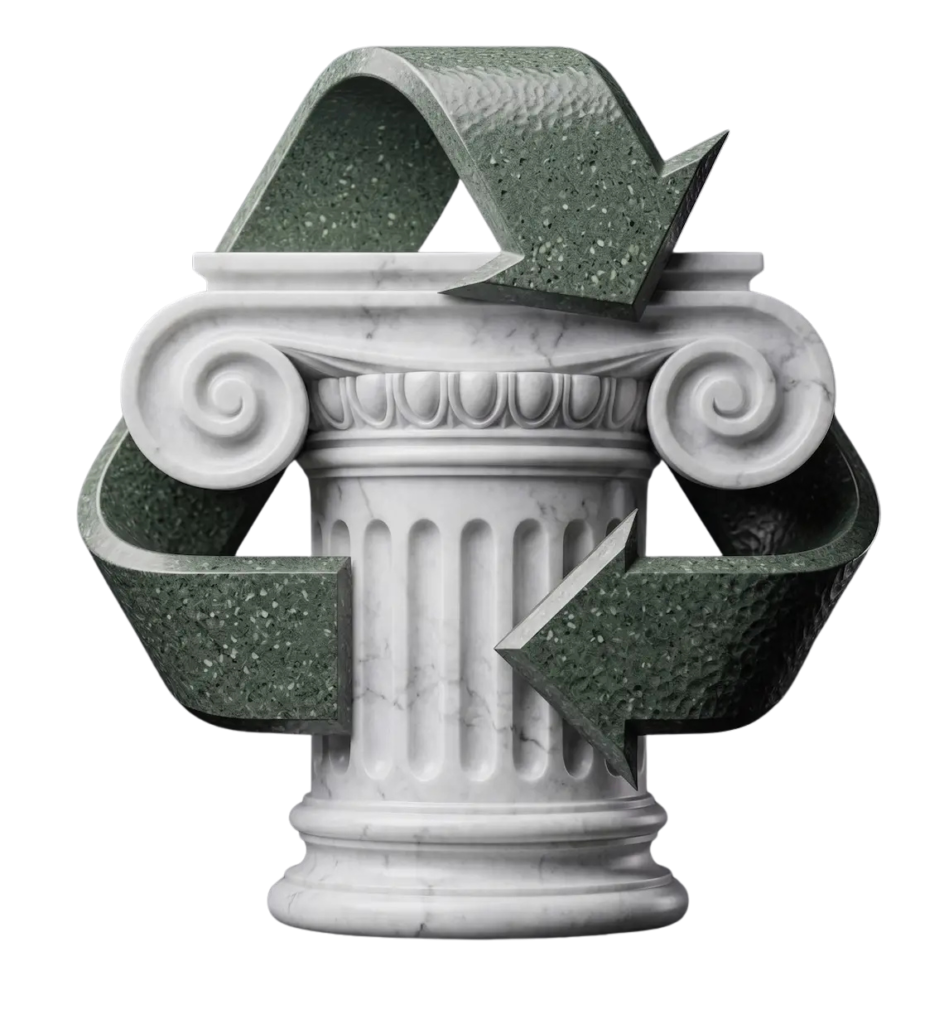
Discover how we are transforming the stone industry by transitioning from a linear to a circular economy. Our goal is to offer sustainable, traceable, and certified stone solutions for the construction of the future.

We are solving one of the biggest problems in this industry

The project introduces the first collection and sorting center for stonemasonry products and stone remnants. With this, we are solving one of the industry's biggest challenges—what to do with excess stone pieces. Instead of ending up as waste, materials that are still suitable will be reprocessed and returned to use. 

The goal of the project is to establish a circular economy in stonemasonry, reduce the environmental impact, and simultaneously create added value from stone that would otherwise remain unutilized.

Innovative strategy of the company Construction s d.o.o.

Who we are and our vision

Construction s d.o.o. operates in the field of stonemasonry and covers the entire value chain—from quarrying to the final product. 

With the awareness that requirements in the construction industry are rapidly tightening toward sustainability, we have adopted a clear vision: we want to become the leading provider of certified sustainable stone and the central platform for the circular use of stone materials in the region.

We are moving beyond the traditional stonemasonry model and establishing ourselves as an innovative player that combines sustainability, digitalization, and efficient resource management.
Smo tudi člani sekcije kamnarjev pri GZS.

Industry challenges that we are solving

The traditional stone industry today faces serious structural and environmental challenges. During the cutting and shaping of stone, between 20% and 50% of waste material is generated, which often remains unutilized. This waste includes everything from larger pieces of stone to fine material and stone sludge produced through the use of water.

Transparency and trust in the market

In addition to the poor utilization of raw materials, the industry lacks systematic traceability—information regarding the origin of the material, processing methods, and transport is lost, which reduces transparency and trust in the market. At the same time, companies mostly do not have standardized data on the carbon footprint of their products available, making it difficult to access more demanding and sustainably oriented construction projects.

Strategy of the three pillars

To solve these challenges, we at Construction s d.o.o. have developed a comprehensive strategy based on three interconnected pillars. These pillars enable the transition from a linear model (take-use-dispose) to a modern circular system

Digital portal for secondary stone materials

We are establishing a central digital platform (portal) that will connect waste material providers, such as stone cutters and construction companies, with end users of secondary raw materials. The portal acts as a digital marketplace through which we enable the collection, processing, and remarketing of materials, thereby returning value to materials that would otherwise become waste.

Traceability system and Digital Product Passport (DPP)

We are introducing an innovative traceability system, or digital product passport (Digital Product Passport). Each piece or batch of material receives a unique identification tag (e.g., a QR code) to which key data is linked: quarry origin, processing method, transport, and environmental indicators. This transparency provides customers and partners with full traceability of the material throughout its entire life cycle.

Quantification of environmental impacts and certification (LCA and EPD)

We perform life cycle assessments (LCA) to accurately measure our carbon footprint and other environmental impacts. By obtaining Environmental Product Declarations (EPDs), we can clearly and transparently demonstrate the sustainability of our materials. This is crucial for integration into sustainable construction certification schemes, such as BREEAM and LEED, as well as for participation in public and European-funded projects.

Zero Waste strategy and circular material flows

Zero Waste strategy is at the core of our operational model, with the goal of maximizing stone utilization and reducing waste to a minimum.


 We divide material flows into three circular loops:


Reuse: Larger stone remnants left over from cutting are used with minimal additional processing for smaller products, such as paving stones, cladding, or decorative elements.


Recycling: Broken material and fragments are processed through crushing and sorting into secondary raw materials and aggregates, which are in high demand in the construction industry.


Low-value use (Downcycling) and innovative sludge management: Stone sludge (dust with water) represents the greatest logistical and environmental challenge. We address it by seeking possibilities for its processing and reuse as a filler in the cement industry or in the production of composite materials.

Stone with added value

Certified Sustainable Stone

By combining data on traceability, life cycle assessments, and waste reduction, we are developing a premium product called certified sustainable stone (Certified sustainable stone).

This product is the ideal choice for architects, designers, and construction companies looking for: materials with a verifiable and low carbon footprint, full compliance with the latest European regulations and sustainable construction requirements, reduced risks, and higher aesthetic value with an emphasis on the story of the circular economy (reuse)

Let's connect and build a sustainable future

Povežimo se in gradimo trajnostno prihodnost

For the successful operation of our circular ecosystem, we seek cooperation with industry, stonecutters, construction companies, and research institutions.


If you are an architect looking for materials with EPD certificates for your next sustainable project, or a construction company looking to optimize the management of your own waste materials, we invite you to become part of our circular platform. Together we can ensure an infinite lifespan for natural stone and contribute to the decarbonization of the construction sector.

Content Hub

The discourse surrounding sustainable building materials frequently overlooks the enduring advantages of natural stone. While contemporary innovations often promise eco-friendly solutions, the inherent properties and historical precedence of stone offer a profound lesson in true longevity and reduced environmental impact. Unlike many manufactured alternatives with complex production cycles, natural stone stands as a testament to sustainable construction, embodying a unique blend of durability and minimal processing requirements.

Read more »

The marvels of ancient Roman engineering, from the Pantheon’s dome to the sprawling aqueducts, stand as testament not only to human ingenuity but also to an inherent understanding of durable, long-lasting construction. Often overlooked in discussions of traditional stonemasonry, Roman concrete, or *opus caementicium*, employed principles that resonate profoundly with today’s pursuit of sustainable stonework and building with stone. This ancient material, a composite of volcanic ash (pozzolana), lime, water, and various aggregates, offers a compelling historical blueprint for eco-conscious construction practices.

Read more »

The enduring appeal of natural stone in architecture is undeniable, yet its sustainability hinges significantly on how efficiently it is sourced, processed, and utilized. Beyond the inherent durability of building with stone, true sustainable stonework practices embrace a philosophy of zero waste, maximizing every fragment and extending the material’s lifecycle. This approach, rooted in historical necessity and refined by modern eco-conscious quarrying, minimizes environmental impact while preserving the aesthetic and structural integrity of stone construction.

Read more »

Natural stone has served as a foundational building material for millennia, often celebrated for its aesthetic appeal and structural integrity. Yet, its environmental performance, particularly concerning its carbon footprint and overall lifecycle impact, frequently remains underestimated. This post delves into the scientific rationale behind natural stone’s position as a genuinely sustainable building material, evaluating its embodied carbon, durability, and end-of-life characteristics against common modern alternatives. Understanding these metrics provides a clearer picture of stone’s contribution to eco-conscious construction.

Read more »

The pursuit of sustainable construction often focuses on operational energy efficiency once a building is complete. However, the environmental impact begins much earlier, with the ’embodied carbon’ of materials used in construction. Embodied carbon represents the total greenhouse gas emissions generated throughout a material’s lifecycle, from extraction and manufacturing to transportation, installation, and eventual disposal or recycling. For centuries, natural stone has been a foundational building material, yet its embodied carbon profile is frequently overlooked or misjudged in contemporary discussions about green architecture.

Read more »

The discourse surrounding sustainable building often champions innovations like advanced composites or engineered wood, yet the environmental credentials of natural stone are frequently overlooked. This overlooks a fundamental truth: stone, when responsibly sourced and expertly applied, offers a compellingly low environmental impact throughout its lifecycle, often surpassing materials perceived as “modern” or “green.” A closer examination of embodied energy, carbon footprint, and long-term durability reveals natural stone as a cornerstone of genuinely sustainable construction.

Read more »

Natural stone has shaped human architecture for millennia, a testament to its unparalleled durability. Beyond aesthetic appeal and structural integrity, a deeper scientific examination reveals stone’s inherent sustainability, particularly when considering its exceptionally long lifecycle and comparatively low carbon impact over centuries. Understanding the true environmental footprint of building materials requires a holistic view, moving beyond initial production to encompass the entire lifespan of a structure.

Read more »

Natural stone has served as a primary building material for millennia, a testament to its intrinsic strength and aesthetic appeal. Beyond its visual charm, contemporary analysis reveals that stone offers significant advantages in sustainable construction, particularly when considering its lifecycle and environmental impact. Understanding the scientific basis of stone’s durability and its low carbon footprint is crucial for architects, builders, and property owners aiming for truly sustainable outcomes.

Read more »

Natural stone has been a foundational building material for millennia, prized for its strength, aesthetic appeal, and remarkable longevity. While stone itself embodies sustainability through its inherent durability, the methods of its extraction and transportation significantly influence its overall environmental footprint. Understanding how ancient civilizations sourced stone provides valuable insights for developing more eco-conscious quarrying and supply chain practices in contemporary stonework.

Read more »

In an era increasingly focused on environmental stewardship, the building industry faces a critical imperative to adopt sustainable practices. While modern materials often grab headlines for their perceived innovations, natural stone, a cornerstone of human construction for millennia, offers a profoundly compelling argument for its enduring environmental benefits. Examining the full lifecycle of building materials reveals that stone frequently outperforms many contemporary alternatives in terms of genuine sustainability and minimal ecological impact.

Read more »
en_USEnglish